August 2, 2027 · Night will fall at mid-morning.

The total solar eclipse of August 2, 2027 in Spain

On August 2, 2027, 105 Spanish municipalities across 6 provinces fall inside the path of totality, with a maximum of 4 min 48 s in Ceuta and a magnitude of 1.07. Search your municipality for the exact timings, the Sun's altitude above the horizon and the historical climate at your observation point.

340d23h26m20s
20:17 — 20:34 CEST

The shadow crossed Spain in seventeen minutes.

A path about 290 km wide swept across northern Spain at sunset. Within it, 3,963 municipalities saw the solar disk completely covered.

20:26 CEST — Asturias and Galicia

It entered along the Asturias-Galicia coast.

The first point of contact with land was Gozón (Asturias): totality began there at 20:26:36 and lasted 104 seconds. In A Coruña it began half a minute later, at 20:27:35, and lasted 76 seconds. The Sun was already very low, 10–12° above the horizon.

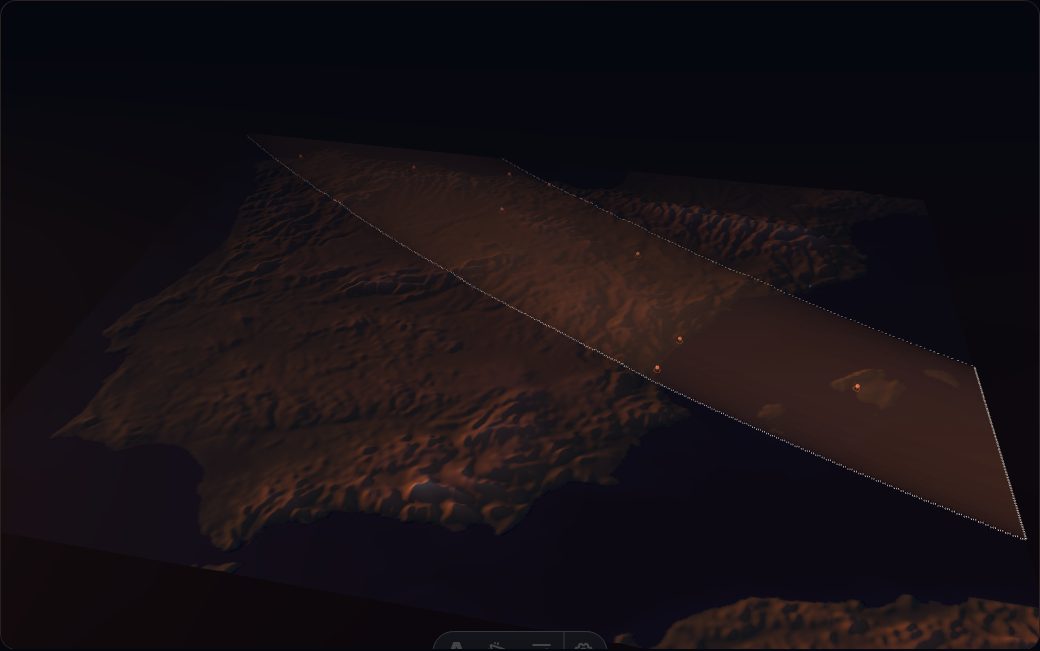
Path of the umbra

Straight on toward the southeast.

The Moon's shadow moved across the Earth's surface at over 3,000 km/h — far faster than the rotation of the subsolar point itself. Scrub to follow its real advance from Galicia to the meseta.

Meseta — Burgos and Zaragoza

1m 50s of totality in El Franco, Asturias.

The point of longest duration over Spanish territory. Burgos was the province with the most municipalities in the path (371), followed by Guadalajara, Zaragoza and Teruel. The amber gradient marks the real duration, from edge to core.

20:33 CEST — Mediterranean

It exited through Castellón, Valencia and the Balearic Islands.

Palma saw totality; Madrid and Barcelona fell outside the path and saw a very deep partial eclipse, without the Sun ever being fully covered.

Free mode

Explore the whole path with your own hands.

Let go of the camera: drag to rotate, scroll to zoom, middle or right button to pan. The time slider moves through the 277 real positions of the shadow.
Search

Your municipality

Search among Spain's 8,131 municipalities. You'll see the real 3D terrain around your location, where the Sun will be at the key moment, and an estimate of whether the terrain relief might block it.

Prefer a list? See your municipality's timings page →

Key figures

The eclipse in numbers

Figures derived from the IGN's official municipality table and the geographic layers of the IGN eclipse viewer.

Interactive 3D map with the real terrain of Spain, the path of totality and the animated eclipse umbra
1m 50s
Maximum duration of totality in Spain (El Franco, Asturias)
2°–12°
Range of the Sun's altitude above the horizon within the path
500–660 km
Width of the path on the ground (widens toward the southeast as the Sun gets lower; E–W cross-section over the official IGN outline)
1,03
Eclipse magnitude within the path of totality
3.963
Of Spain's 8,131 municipalities saw totality (31 provinces)
Aug 2, 2027
Next total eclipse visible from southern Spain
Data: IGN · eclipses.ign.es

Cities with official IGN data

CityTotalityMaximumDurationSun altitudeAzimuthScore
Data: IGN municipality table (eclipses.ign.es). Local times, referenced to each municipality's reference point.
Fun facts

Fun facts about the 2026 eclipse

Climatology 1996–2025

Is 12 August usually clear?

The eclipse arrived at sunset with the Sun very low, so clouds to the west mattered just as much as being inside the path. Thirty 12ths of August of meteorological reanalysis (1996–2025) draw a clear pattern: the further southeast and closer to the Mediterranean, the better the odds of clear skies.

On the coast of Valencia and in Ibiza, 12 August has dawned clear in 23 of 30 years (77%), with average cloud cover of only 19–22%. It was the stretch with the best odds along the entire path of totality.

At the opposite end, the mountainous interior of Asturias and Lugo — right where the shadow enters Spain — has only been clear 1 of 30 years (3%), with average cloud cover of 61–69%. It was, by far, the stretch with the highest risk of clouds.

Between these two extremes, the eastern meseta and the Ebro valley — Zaragoza, Teruel, Guadalajara — offered a solid bet: between 15 and 18 of 30 years clear (50–60%), with average cloud cover of 26–29%. But the advantage faded quickly moving north: in Burgos, already on the edge of humid Spain, the share drops to 7 of 30 clear years (23%) and average cloud cover rises to 47%.

The map above has a "% clear years" layer with this same data draped over the terrain. But the municipality search gives the exact figure for your observation point, not the average of a 25 km grid cell.

Climatology: ERA5 reanalysis 1996–2025, 29 Jul–26 Aug window.
Eye safety

How to watch the eclipse without damaging your eyes

Looking directly at the Sun, even during a partial eclipse, can cause serious, irreversible eye damage in seconds.

Ground level

Province by province

Where the path of totality actually falls, where only a partial eclipse is left, and what each province page contains.

A solar eclipse does not treat everyone the same. Being inside the path of totality rather than twenty kilometres outside it is not a difference of degree but of kind: inside, night falls and the corona appears; outside, you get a slightly odd afternoon with a bite taken out of the Sun. That is why the data on this site is organised by province and by town, and not by region or tourist area.

The provinces of the next eclipse

The path of the next total eclipse does not cross Spain end to end. It enters at the far southern tip and also reaches the two autonomous cities on the North African coast, which makes for a short strip: most of the country is left with a partial eclipse this time, however high the percentage of covered Sun quoted by a local forecast may sound.

These are the provinces inside the path. Each will get its own page, with the full list of towns and their timings, as soon as the town-level figures for that event are computed and published; until then, the eclipse page gathers everything already available: when the shadow enters and leaves the country, the magnitude, the longest totality and the exact place where it is reached.

  • Almería
  • Ceuta
  • Cádiz
  • Granada
  • Melilla
  • Málaga
See 2027 →

The archive of the eclipse that already happened

The total eclipse that crossed the mainland from north-west to south-east has been and gone. Its pages are not being taken down: they stay on as an archive, because they document a real path of totality over Spanish ground in a level of detail that rarely survives the day after the event.

Each province page collects the towns that fell inside the path, the longest totality reached there, and the historical weather and terrain analysis used, before the date, to decide where it was worth standing. That material does not expire with the calendar: the geometry of the next eclipse will be different, but choosing a spot, reading thirty years of cloud records and checking what stands between you and the western horizon works exactly the same way.

  • A Coruña59 municipalities in the path · 1m 47s
  • Araba/Álava51 municipalities in the path · 1m 23s
  • Asturias78 municipalities in the path · 1m 50s
  • Ávila14 municipalities in the path · 41s
  • Barcelona3 municipalities in the path · 25s
  • Bizkaia56 municipalities in the path · 1m 6s
  • Burgos371 municipalities in the path · 1m 47s
  • Cantabria102 municipalities in the path · 1m 41s
  • Castelló/Castellón135 municipalities in the path · 1m 41s
  • Cuenca121 municipalities in the path · 1m 31s
  • Gipuzkoa6 municipalities in the path · 43s
  • Guadalajara288 municipalities in the path · 1m 43s
  • Huesca57 municipalities in the path · 1m 10s
  • Illes Balears67 municipalities in the path · 1m 36s
  • La Rioja174 municipalities in the path · 1m 41s
  • León211 municipalities in the path · 1m 49s
  • Lleida52 municipalities in the path · 1m 11s
  • Lugo66 municipalities in the path · 1m 49s
  • Madrid93 municipalities in the path · 1m 29s
  • Navarra141 municipalities in the path · 1m 27s
  • Ourense15 municipalities in the path · 1m 8s
  • Palencia191 municipalities in the path · 1m 47s
  • Pontevedra3 municipalities in the path · 35s
  • Segovia204 municipalities in the path · 1m 40s
  • Soria183 municipalities in the path · 1m 45s
  • Tarragona169 municipalities in the path · 1m 38s
  • Teruel236 municipalities in the path · 1m 42s
  • València/Valencia132 municipalities in the path · 1m 24s
  • Valladolid225 municipalities in the path · 1m 43s
  • Zamora183 municipalities in the path · 1m 29s
  • Zaragoza277 municipalities in the path · 1m 43s
All municipalities
Spain's three eclipses

The eclipse trilogy

Spain lives through three solar eclipses in just over two years: the 2026 total, already past; the 2027 total in the south; and the 2028 annular at sunset. Each with its own path, its own municipalities and its own viewing window.

  1. 2027 · TotalT−340 days

    The total eclipse of the south

    Eleven months after the 2026 eclipse, the Moon again fully covers the Sun over Spain — this time in the morning, in the far south: Cádiz, Ceuta, Málaga and Granada.

    105 municipalities in the path6 provinces4m 48s in Ceutam 1.07
    See 2027 →
  2. 2026 · TotalAlready happened

    Night fell twice.

    The first total solar eclipse visible from mainland Spain since 1905. The Moon's shadow entered through Galicia around 20:27, crossed the north of the country at sunset, and exited toward the Mediterranean and the Balearic Islands before 20:35, with the Sun only 2°–12° above the horizon.

    3,963 municipalities in the path31 provinces1m 50s in El Francom 1.03
    See 2026 →
  3. 2028 · AnnularT−518 days

    The ring of fire that crosses all of Spain

    The widest-reaching of the three: the annular path runs the length of Spain, from Huelva to Girona, with the Sun getting lower and lower until it sets while still eclipsed in the northeast.

    3,259 municipalities in the path29 provinces7m 12s in Almontem 0.91
    See 2028 →
12-13 August 2026

The night of the triple event

The very same night the eclipse's shadow crossed Spain at sunset, the Moon turned new —a moonless sky— just as the Perseids reached their peak (ZHR 100, 02:00-04:00 UT). Eclipse, meteor shower and Milky Way with zero moonlight, all in one night.

Source: IMO cal2026 (verified literal quote, see report)
The journal

Latest from the journal

Long-form pieces written from the project's own data, not from someone else's press release.

None of these pieces summarises what another site already says. Each one starts from a table published here and ends at a conclusion you can check by opening the map.

How they are made

Every article in the journal begins in the same place: a figure from the project that is already published and that anyone can open. Concrete questions come out of it, and each piece answers exactly one. How many towns inside the path have their own terrain blocking the horizon. What actually separates an afternoon with 99 per cent of the Sun covered from one with 100. Where the sky has been clear, on that same date, over the last thirty years.

This is the part of the site where a figure stops being a cell in a table and turns into a decision: what time to leave the house, which part of the horizon to face, what to keep in front of your eyes, and at exactly which moment, if any, it can come off.

  1. What we predicted, and what actually happened on 12 August

    This site published a climatological probability, not a forecast. Now that the ERA5 archive covers 12 August 2026 itself, we can download the real cloud cover for all 404 cells of the band and set it beside what we said — without ducking.

  2. Eclipse day logistics: getting there, and getting there early

    The astronomy is fixed and the weather is a gamble, but the part you fully control is where you are standing and when you got there. A plan for 12 August, a date that lands in the middle of Spain's busiest travel month.

  3. After 12 August: the eclipses of 2027 and 2028

    Spain gets three major solar eclipses in three consecutive years. The 2027 total lands in the far south with the Sun high and totality almost five minutes long; the 2028 annular crosses the whole country at dusk. Here is how they compare — and why 2026 is the dress rehearsal for both.

  4. Photographing the eclipse: one filter, one tripod, one plan

    Your eyes and your camera need separate protection, and the fact that this eclipse happens with the Sun almost on the horizon changes both the framing and the rehearsal. A practical guide that ends with the least popular piece of advice: put the camera down.

  5. Totality, minute by minute: what actually happens

    A total eclipse is not an instant, it is a sequence — and almost all of it happens before the Sun disappears. Here is the order in which the light, the temperature, the animals and the sky itself give way, and what the low Sun of 12 August 2026 changes about it.

Every article in the journal →
Frequently asked questions

FAQ

When was the 2026 total solar eclipse in Spain?

On 12 August 2026, the first total solar eclipse visible from mainland Spain since 1905. Totality crossed the north of the country at sunset, between 20:27 and 20:34 local time depending on the city.

Which parts of Spain saw the total eclipse?

3,963 of Spain's 8,131 municipalities, across 31 provinces, saw totality. The path entered through Galicia and crossed diagonally toward the Mediterranean, passing near Oviedo, Santander, Bilbao, Burgos and Zaragoza, and exited through Castellón, Valencia and the Balearic Islands. Look up your municipality in the section above.

Is it safe to look at the eclipse directly?

No. In a TOTAL eclipse you may look without a filter only during the exact seconds of totality, inside the path; in an ANNULAR eclipse there is no safe instant at all, because a ring of photosphere always stays exposed. The rest of the time, certified ISO 12312-2 eclipse glasses are essential.

How long did totality last?

It varied by location: from a few seconds near the edge of the path up to a maximum of 1 minute 50 seconds (110s) in El Franco, Asturias.

Can the terrain block the Sun in my town?

With the Sun so low (2°–12°), it's a real question. In the "Your municipality" section we calculate an estimate comparing the Sun's altitude with the angle of the horizon to the west, using the IGN's official digital terrain model. It's an estimate: it doesn't account for trees or buildings.

What if it's cloudy?

Clouds can block the view even inside the path of totality. Every municipality page in the sky atlas shows 30-year historical averages for cloud cover and clear-sky probability on 12 August — a statistical estimate, not a forecast for the day itself.

When are the next eclipses?

A total solar eclipse crosses southern Spain on 2 August 2027, and an annular "ring of fire" eclipse crosses the whole country at sunset on 26 January 2028.

Can I look directly at the eclipse during totality?

Yes, but only in a TOTAL eclipse and only during the exact seconds of totality, when the Sun's disk is completely covered — that's the only moment it's safe to remove your eclipse glasses. Put them back on immediately as soon as the first sliver of sunlight reappears. In an ANNULAR eclipse that moment never comes: the ring of photosphere never goes dark.